What is AI marketing automation?
Published on April 28, 2026/Last edited on March 31, 2026/11 min read

Team Braze
BrazeContents
93% of marketing leaders say AI gives them more accurate insight into customer preferences and behavior than they had before—yet only 53% of consumers say brands are accurately predicting what they want and need, according to the Braze 2026 Global Customer Engagement Review. That 40-point gap between marketer confidence and customer experience is one of the most telling challenges in modern marketing.
AI-powered marketing automation is changing what's possible. By combining the scale of traditional automation with the intelligence of machine learning and real-time decisioning, it gives marketers a way to engage customers that adapts as behavior changes—not just when rules are manually updated.
This article covers what AI marketing automation is, how it differs from traditional rule-based systems, and why more teams are treating AI-driven customer engagement as a core part of how they plan, build, and run their marketing.
What is AI marketing automation?
AI marketing automation is the combination of traditional marketing automation with artificial intelligence—specifically machine learning, predictive analytics, and real-time decisioning—to create systems that don't just execute campaigns, but continuously learn from customer behavior and adapt to it.
Traditional automation follows instructions. It sends a welcome email when someone signs up, or a reminder when a cart is abandoned, because a rule says so. AI marketing automation works differently. It analyzes behavioral data across every interaction, identifies patterns, predicts what a customer is likely to do next, and determines the best action to take—the right message, the right channel, the right moment—producing engagement that is more relevant and better timed with every interaction that passes.
Why is AI in marketing automation important?
Customer expectations have shifted considerably. People expect brands to know what they want, when they want it—and when a message feels generic or poorly timed, they notice. A McKinsey report found that 71% of consumers expect personalized interactions, and 76% feel frustrated when they don't get them.
Traditional automation was built for a simpler time. Static rules and manual segmentation worked when customer journeys were more linear and channel choices were fewer. Today, customers move between devices, platforms, and touchpoints in ways that fixed workflows can't anticipate. A rule written three months ago has no way of accounting for how a customer's behavior has changed since.
The limitations show up quickly. Segments go stale. Journeys built on assumed behavior miss the mark. Marketers spend time maintaining automation workflows that should be working for them, not the other way around. And because traditional automation can only act on what it's been told to look for, opportunities that fall outside those parameters go unnoticed.
AI-driven customer engagement: From static rules to real-time response
AI marketing automation addresses this by treating every interaction as new information and enabling genuinely AI-driven customer engagement. Rather than following a fixed path, it continuously re-evaluates context—what a customer just did, what they're likely to do next, and what response is most likely to move them forward.
The role of AI in marketing automation is precisely this capacity to adapt in real time, separating systems built for the complexity of modern customer engagement from those that aren't.
AI marketing automation vs. traditional marketing automation
The most important distinction between AI marketing automation and traditional marketing automation isn't speed or scale—it's how decisions get made.
Traditional marketing automation is rule-based. Marketers define the logic: if a user does X, send Y. Those rules can be sophisticated, but they're still fixed. They reflect what the team knew and anticipated when the workflow was built, and they stay that way until someone manually updates them. Segmentation is static, journeys are predetermined, and optimization happens after the fact—usually through A/B tests that take time to set up, run, and analyze.
AI-powered automation shifts that dynamic. Machine learning models analyze behavioral patterns, predict likely outcomes, and inform what happens next—without requiring marketers to map every possible path in advance. Segmentation can update continuously as behavior changes, and cross-channel orchestration replaces the need for manual testing cycles.
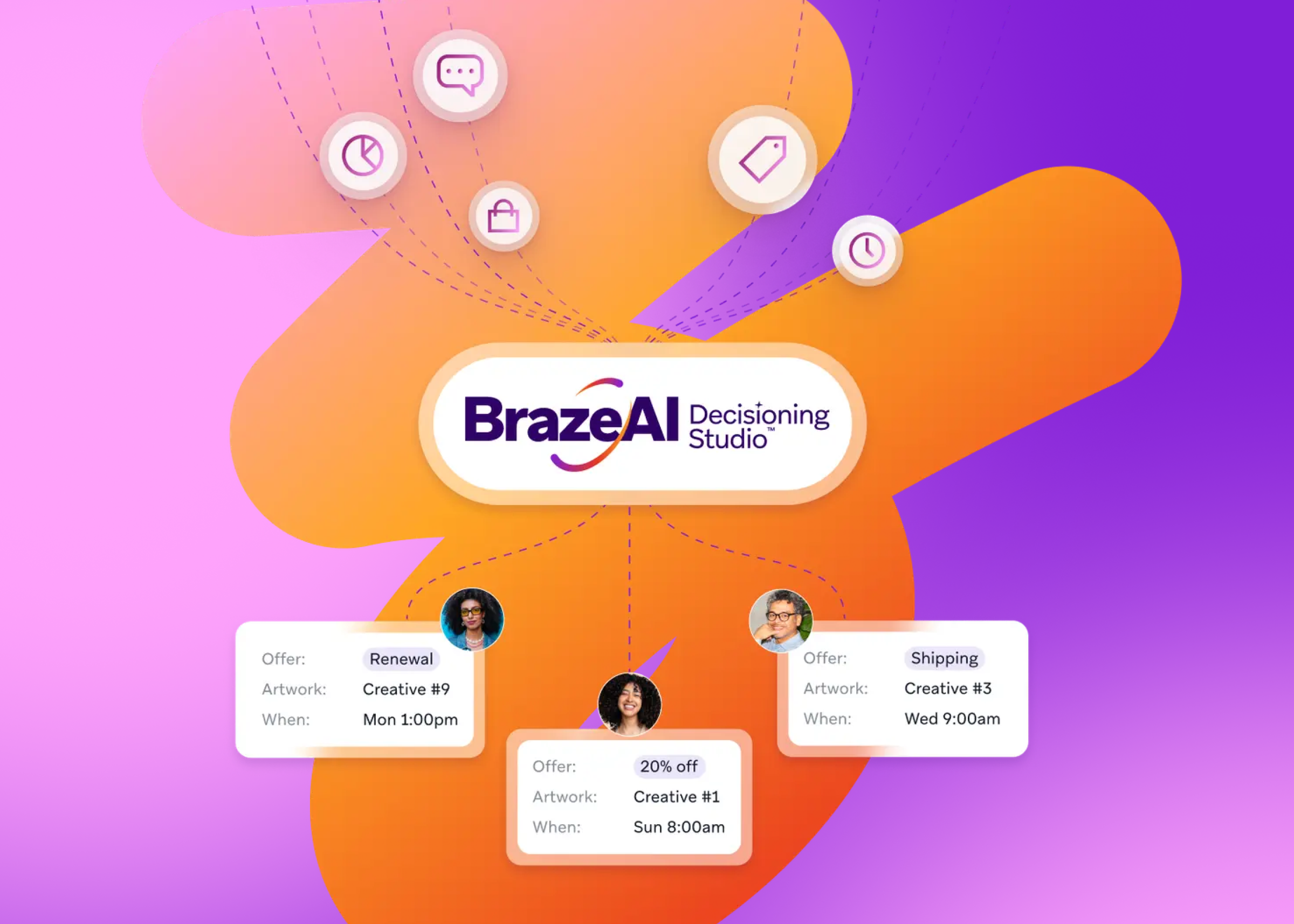
The more advanced expression of this is AI decisioning, which goes further than predicting the next-best action. Where traditional predictive models typically recommend a single dimension—most often a product or offer—AI decisioning, built on reinforcement learning, optimizes across all variables simultaneously: message, channel, timing, frequency, creative, and incentive. Crucially, it makes those decisions at the individual level, not the segment level, learning from each interaction to improve future outcomes without needing to be retrained.
The table below shows how the approaches compare across the areas that matter most:
Traditional automation | AI-powered automation | |
|---|---|---|
Triggers | Predefined rules | Real-time predictive signals |
Segmentation | Static, manually updated | Dynamic, continuously adaptive |
Personalization | Rule-driven content swaps | Predictive content, timing, and recommendations |
Optimization | Manual A/B testing | Continuous, automated learning |
Scalability | Complex to scale | Built for high volume and variability |
Rule-based automation still has a place in straightforward, high-certainty workflows. But for teams managing complex, multi-channel customer journeys at scale, the gap in what each approach can deliver becomes significant—and that's where revisiting your marketing automation strategies becomes worthwhile.
How AI-powered marketing automation improves outcomes
Understanding what AI can do conceptually is one thing, but for most marketers, the more pressing question is what it actually changes about the work and the results.
The most immediate difference is in prediction. Rather than waiting to see how a campaign performed before making adjustments, AI marketing automation continuously evaluates behavioral signals to anticipate what a customer is likely to do next. That might mean identifying someone who is close to converting, recognizing early signs of disengagement, or spotting the moment a lapsed customer is most likely to respond. Acting on those signals in real time—rather than in the next campaign cycle—changes both the relevance and timing of every interaction.
The most sophisticated AI systems go beyond predicting a single next action to optimizing every variable around it simultaneously. That precision has a direct effect on manual workload. Teams that previously spent significant time building and maintaining campaign logic, rerunning tests, and updating segments can redirect that effort toward strategy and creative, while the system handles continuous marketing optimization in the background.
What tends to surprise marketers most is the compounding effect. Because AI learns from every interaction, performance doesn't plateau the way manually managed automation workflows do. The more the system runs, the more accurately it can anticipate behavior—and the wider the distance grows between what AI-powered marketing automation delivers and what static rules alone can achieve.
Core capabilities of AI marketing automation
AI marketing automation draws on several distinct but interconnected capabilities. Together, they form the foundation of how these systems learn, decide, and improve—and understanding each one helps clarify why the whole becomes greater than the sum of its parts.
Marketing automation using AI: Machine learning and predictive models
Machine learning is what allows marketing automation using AI to move beyond fixed logic. By analyzing patterns across large volumes of behavioral, transactional, and engagement data, predictive models can identify signals that would be impossible to spot manually—who is likely to convert, who is beginning to disengage, which content is most likely to resonate with a given individual. These models don't require marketers to define what to look for; they find the patterns themselves, continuously updating as new data flows in.
Real-time decisioning
Predictive insight only creates value when it can be acted on quickly. Real-time decisioning is the mechanism that translates what a model knows about a customer into an action, delivered at the point it's most likely to make a difference. This is what separates AI marketing automation from systems that analyze behavior in batches and apply changes retroactively.
Personalization at scale
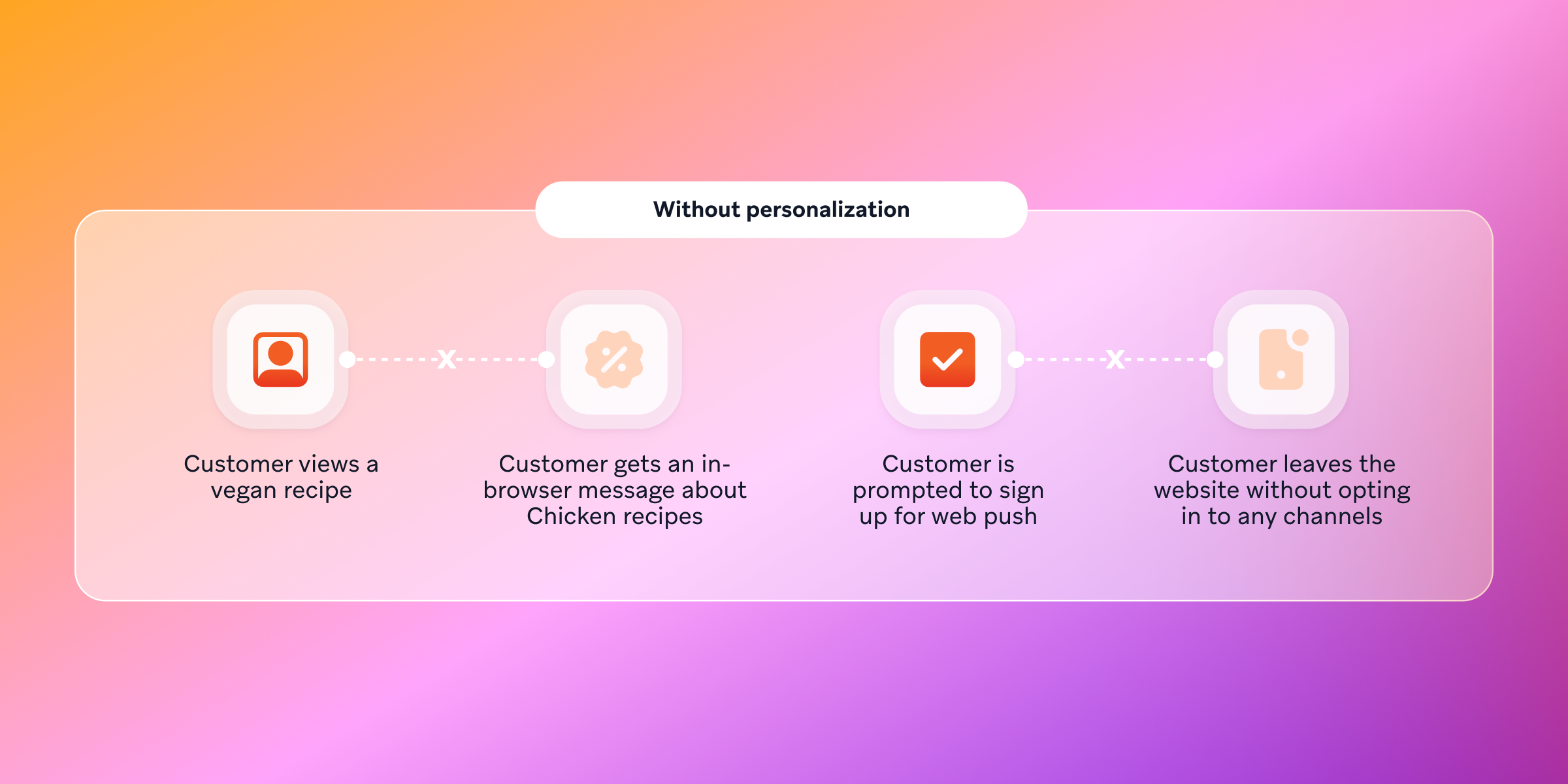
Rule-based personalization is limited by the number of rules a team can realistically build and maintain. AI removes that ceiling. By learning from individual behavioral patterns rather than applying segment-level logic, AI-powered marketing automation can create experiences that feel genuinely tailored—across millions of customers simultaneously—without a proportional increase in manual effort.
Continuous learning through experimentation
AI marketing automation doesn't settle on a single approach and hold to it. It experiments continuously—testing variables, measuring responses, and updating its models based on what it observes. This means campaigns improve on an ongoing basis, with each interaction contributing to a more accurate picture of what works for each individual. The system is always in motion, always learning, and always refining.
Data requirements for AI marketing automation
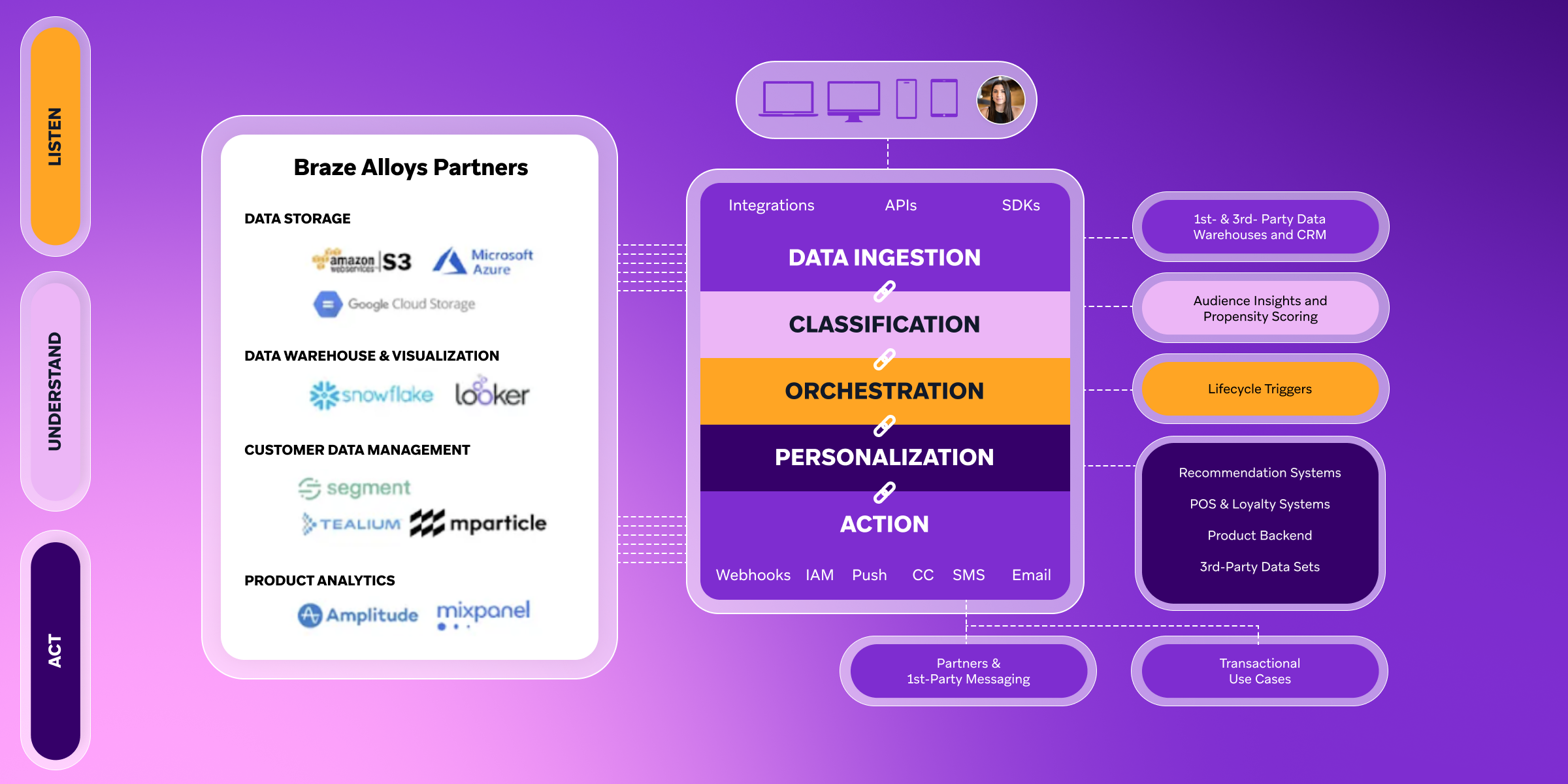
AI marketing automation is only as capable as the data that powers it. The sophistication of the models, the accuracy of the predictions, and the relevance of every interaction all depend on having the right data available—in the right form, at the right time. This is as true for marketing automation using AI as it is for any intelligence-driven system. Better data inputs produce better outputs.
First-party behavioral data
The most valuable input for AI marketing automation is first-party behavioral data—the actions customers take directly with a brand. Browsing patterns, purchase history, app activity, email engagement, content interactions—these signals reveal intent and preference in a way that demographic data alone cannot, and they form the foundation of any effective lifecycle marketing strategy. The richer and more complete this behavioral record, the more accurately AI can predict what a customer is likely to do next.
Event and interaction data
Beyond broad behavioral history, AI marketing automation benefits significantly from granular event-level data—the specific moments that mark meaningful points in a customer's journey. A product viewed, a cart abandoned, a subscription renewed, a support ticket raised. These events provide the real-time context that allows AI systems to respond to what's happening now, not just what happened in aggregate over the past month.
Real-time data availability
Data that arrives hours or days after an interaction has limited value for a system designed to act in the moment. For AI marketing automation to make timely decisions, customer data needs to flow continuously and update instantly. A customer who browses a product at 9 a.m. and receives a relevant follow-up message that afternoon had a very different experience from one who receives the same message three days later. Real-time data availability is what makes the difference between automation that feels responsive and automation that feels out of step.
Responsible, consent-driven data usage
The depth of data that makes AI marketing automation effective comes with a clear responsibility. Customers share their behavior—implicitly and explicitly—with an expectation that it will be used to improve their experience, not exploited. Consent-driven data collection, transparent data practices, and compliance with privacy regulations are legal requirements and the foundation of the trust that makes personalization welcome rather than intrusive. AI that operates on responsibly collected first-party data is not only more ethical, it tends to perform better, because the data it learns from reflects genuine customer relationships.
AI marketing automation across the customer lifecycle
AI marketing automation doesn't apply to a single moment in the customer relationship. It supports the full arc of AI-driven customer engagement, from the point a customer first interacts with a brand through to long-term retention and growth, with orchestration connecting every stage into a coherent whole.
Onboarding and activation
First impressions have an outsized impact on whether a new customer becomes an active one. AI can identify which early experiences are most likely to lead to meaningful activation for different user types, and adapt the journey in response to how each individual is actually engaging, rather than moving everyone through the same predefined sequence. Users who show early signs of dropping off can be identified and engaged before disengagement becomes a pattern.
Engagement and conversion
For active customers, AI works to connect intent with opportunity. Behavioral signals—what someone is browsing, how frequently they're returning, which categories they're gravitating toward—give AI the context to time and shape outreach around genuine interest rather than a scheduled send. The difference shows up in conversion rates, because messages that reflect actual intent tend to perform better than those based on assumed interest.
Retention and re-engagement
Churn rarely happens without warning. Predictive models can detect subtle shifts in behavior—a decline in session frequency, changes in purchase patterns, reduced email engagement—well before a customer explicitly disengages. This early visibility gives marketing teams the opportunity to act while there's still a meaningful relationship to protect, with responses calibrated to each individual rather than a generalized retention playbook.
Lifecycle optimization
What makes AI marketing automation particularly valuable across the lifecycle is that each stage informs the next. Onboarding insights shape engagement strategies. Engagement patterns reveal retention risks earlier. Retention learnings feed back into how new customers are acquired and welcomed. The lifecycle becomes a connected system rather than a series of isolated campaigns—one where intelligence accumulated at every stage makes the whole lifecycle marketing program stronger over time.
AI marketing automation FAQs
What is AI marketing automation?
AI marketing automation combines traditional marketing automation with artificial intelligence—machine learning, predictive analytics, and real-time decisioning—to create systems that learn from customer behavior and adapt to it. Rather than following fixed rules, AI marketing automation predicts outcomes and determines the most relevant action for each individual in real time.
How is AI used in marketing automation?
AI is used in marketing automation to analyze customer data, predict outcomes, and determine the best next action for each user. This can include sending the right message at the right time, recommending products, detecting churn risk, and optimizing entire customer journeys without manual setup.
What are examples of AI-powered automation tools?
Examples of AI-powered automation tools features like predicting churn, recommending products, and automatically personalizing journeys as customers change.
How is AI marketing automation different from traditional marketing automation?
The key difference between AI marketing automation and traditional marketing automation is how decisions get made. Traditional automation follows fixed rules and static segments, while AI marketing automation uses machine learning to analyze behavior, predict outcomes, and adapt continuously.
What problems does AI marketing automation solve for marketers?
AI marketing automation solves persistent challenges including the inability to personalize at scale, the time cost of maintaining campaign logic, and the lag between insight and action. It handles continuous optimization automatically, freeing teams to focus on strategy and creative.
How does AI improve personalization and timing in marketing automation?
AI improves personalization and timing in marketing automation by learning from individual behavioral signals rather than segment rules. It anticipates what each customer is likely to do next and determines the most relevant message and optimal moment to deliver it.
What data is required for AI marketing automation to work effectively?
AI marketing automation works most effectively with rich first-party behavioral data—purchase history, browsing activity, app engagement, and event-level interactions—available in real time. Consent-driven data collection is also essential, both as a legal requirement and the foundation for meaningful personalization.
Related Tags
Be Absolutely Engaging.™
Sign up for regular updates from Braze.
Related Content
 Article16 min read
Congratulations to the Forge 2026 Torchie Awards winners
September 29, 2026 Article6 min read
Bring 1:1 decisioning to every marketing journey with BrazeAI Decisioning Studio™ Go
September 28, 2026 Article12 min read
Made for this: How Braze is providing new ways to build, support, and extend your campaigns
September 28, 2026